Penombra
Mayfair
- Concept. A fictional 36-seat restaurant; nothing here can be booked.
- Name and positioning, wordmark, lockup and monogram, art direction, seventeen generated photographs, menu and copy, a one-page website.
- First version 7 November 2026; this Mayfair version 8 November.
- Higgsfield (GPT Image 2.6), an outlined Cormorant monogram, GSAP, ScrollTrigger, Lenis, Chrome for QA.
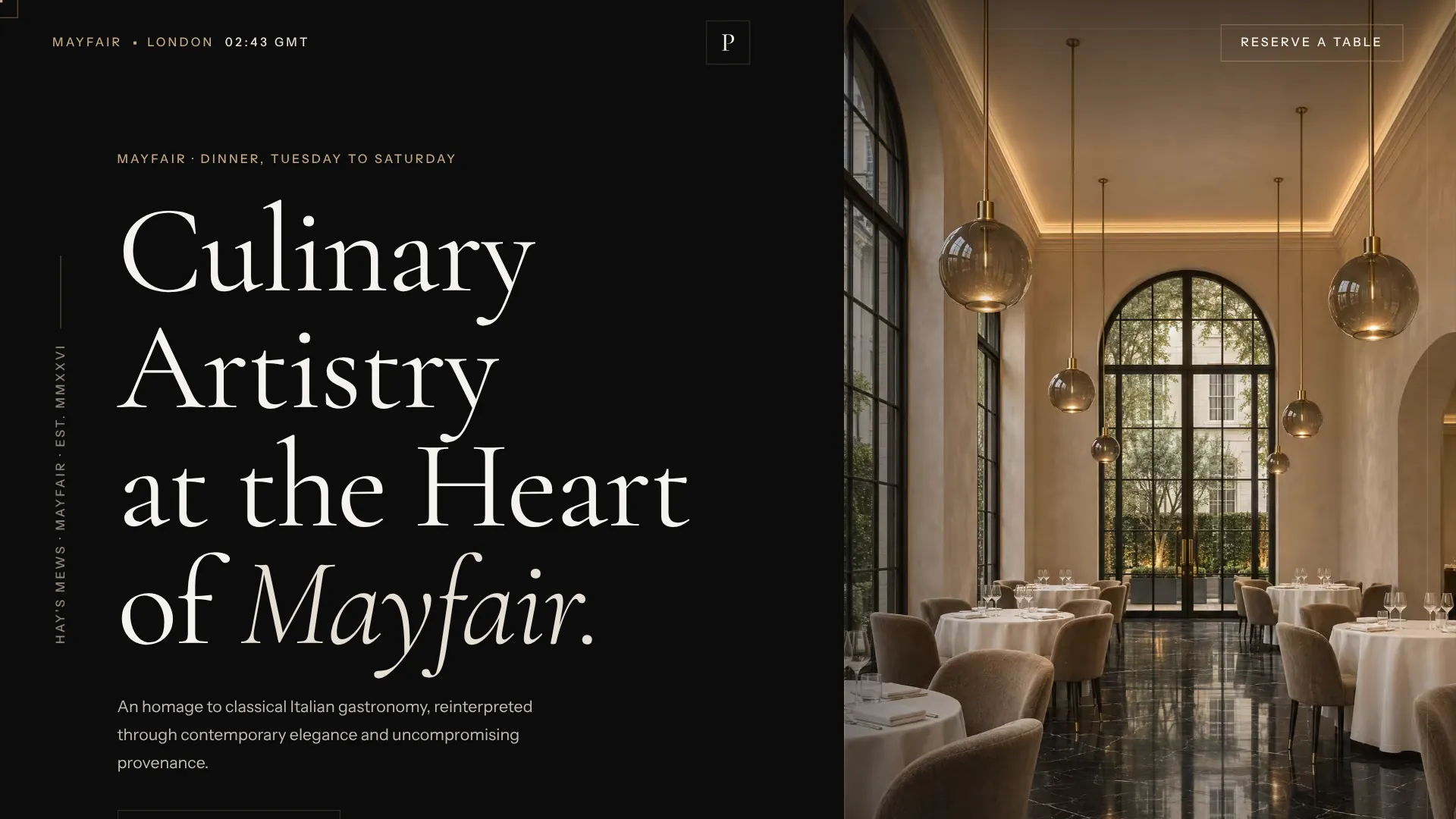
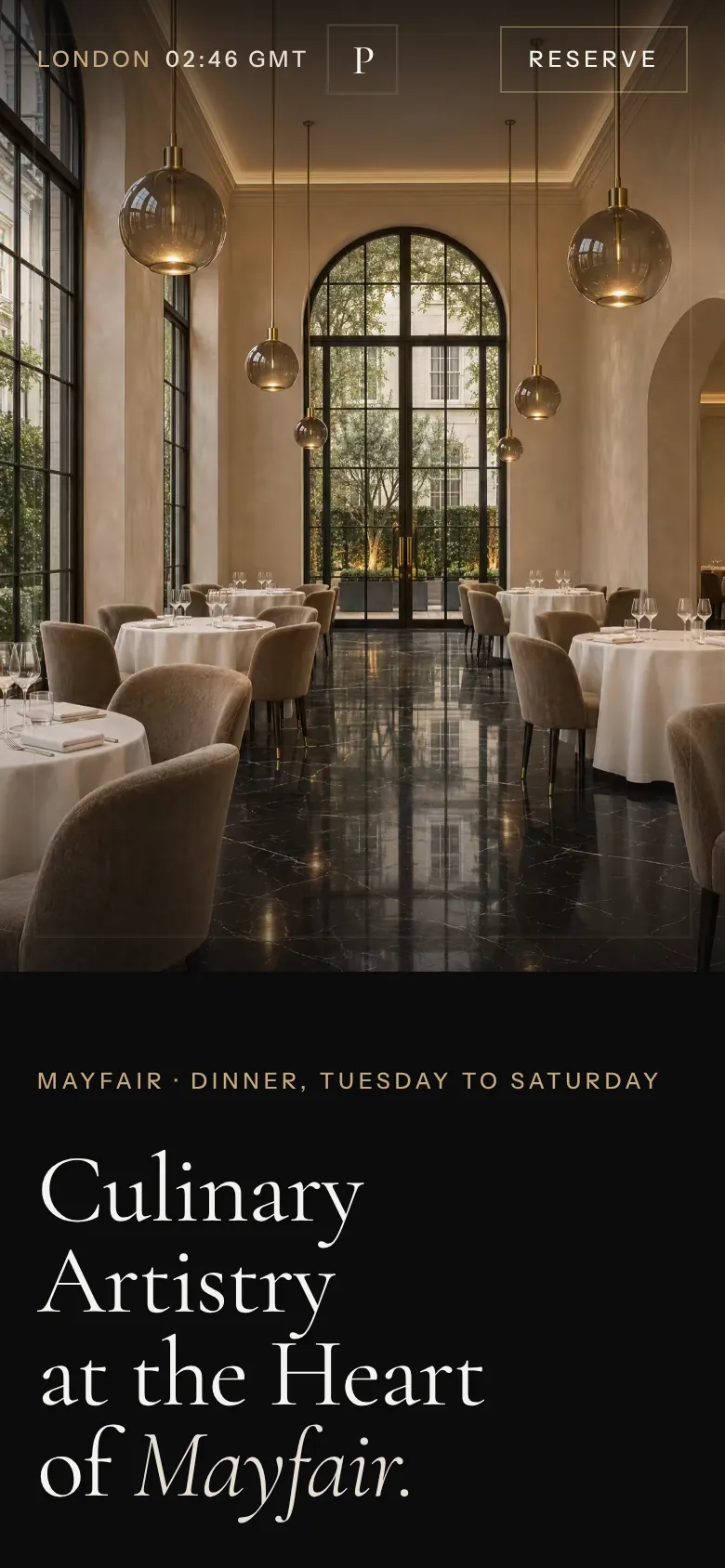
A double-height carriage hall on Hay's Mews: Nero Marquina underfoot, brass at the cornice, thirty-six seats and one service a night. Classical Italian cooking, dinner only, Tuesday to Saturday.
The same restaurant, moved up the street.
The first Penombra was a coach-house trattoria: a hearth, pasta rolled at three, candles, walk-ins at the counter. The second brief asked for the same restaurant in an ultra-exclusive Mayfair register, at award standard. So the room became a members'-club dining room, and everything rustic went: hearth, embers, oak, candles, the counter and the line about a small kitchen.
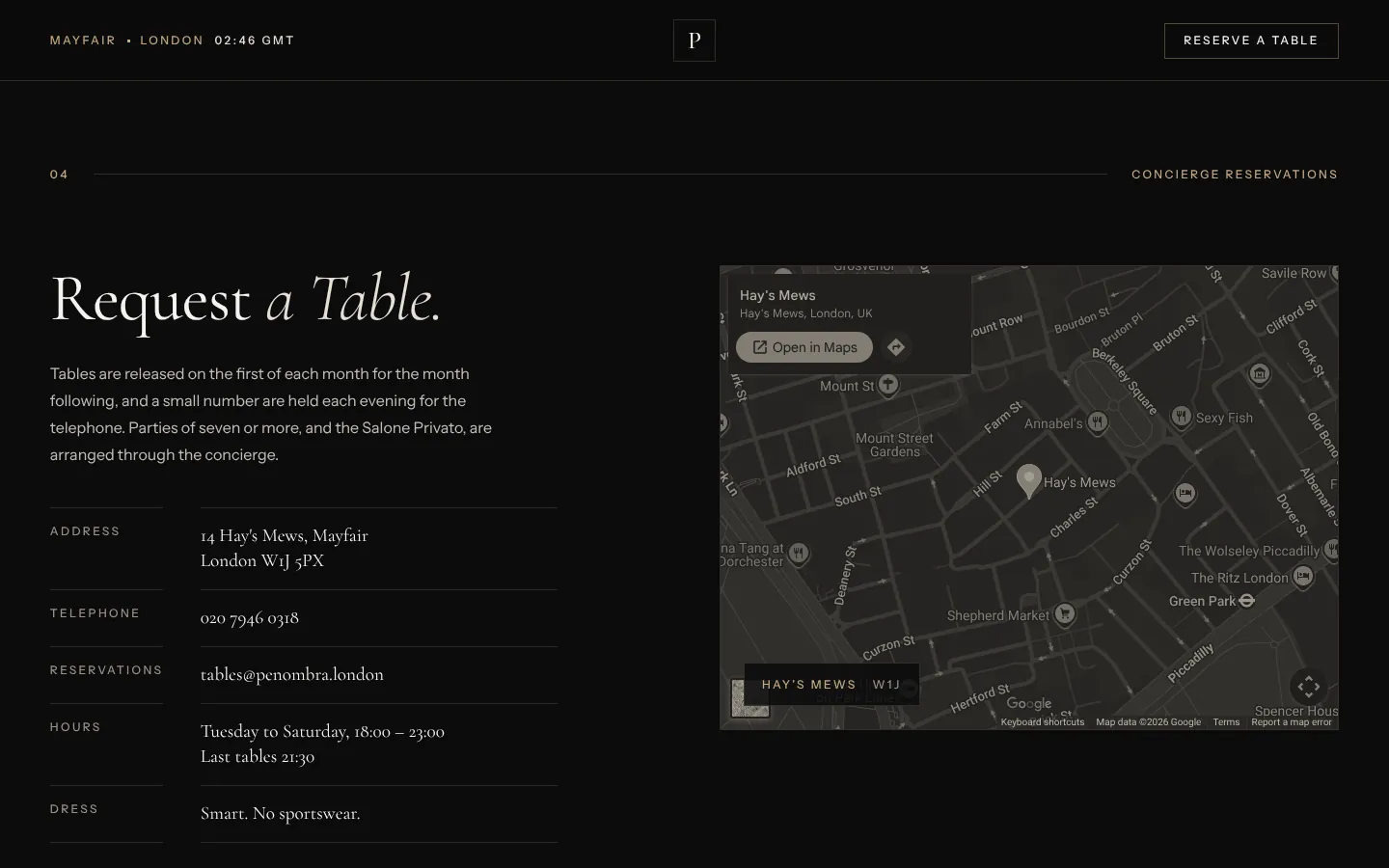
What stayed is what made it Penombra: Hay's Mews, thirty-six seats, Tuesday to Saturday from 18.00 to 23.00, a telephone number from the drama range that cannot connect, and a footer that says the restaurant is fictional.
Penombra. Italian for half-light.
The dimness between lamp and shadow. It still fits a room lit low, and it reads in English without explanation. The secondary line is Mayfair · London.
Name check, 7 November 2026: a small wine bar in Malmö trades as La Penombra; nothing in the UK. Enough for a concept. A real opening would start with a Class 43 trademark search.
A wordmark, a lockup and a P in a brass square.
PENOMBRA set in widely spaced Cormorant Garamond capitals, a short hairline beneath, MAYFAIR · LONDON in small sans capitals under that. The monogram is a P outlined from Cormorant Garamond 500 and set in a one-pixel brass square; on the site it sits at the centre of the header, held there by an equal-column grid.
Each piece comes as outlined SVG, so nothing depends on a font being installed: the lockup and wordmark in ivory and obsidian, on transparent and on their own grounds, and the monogram in ivory, obsidian and brass.
Obsidian, ivory, champagne, brass.
The first version ran on smoke black, bone and terracotta. This one is darker and colder, with antique brass as the only warm note, used for hairlines, the monogram and one filled button. Every line on the page is one pixel of brass at 20% opacity. Corners are square everywhere; the QA run fails on any element with a radius.
Contrast was measured, not assumed: ivory on obsidian 17.8:1, champagne 14.9:1, brass 8.7:1, taupe 6.3:1 (6.1:1 on onyx). Obsidian text on the brass button is 8.7:1.
- Obsidian#0B0B0C
- Onyx#111113
- Taupe#9A9185
- Brass#C5A880
- Champagne#E6DFD5
- Ivory#F5F3EF
Cormorant Garamond and Instrument Sans.
Cormorant Garamond from 300 to 500, roman and italic, for every headline and dish name; in the hero the lines rise and their letter-spacing tightens as they arrive. Instrument Sans for metadata at 0.75rem in capitals with 0.2em of tracking. Both are under the SIL Open Font Licence. The delivered page loaded them from Google Fonts; on this site they are self-hosted subsets.
Penombra
Instrument Sans 500, 0.75rem, caps, +0.2em
Cormorant Garamond 400
Cormorant Garamond 300 italic
Marble, brass, linen and glass. No fire.
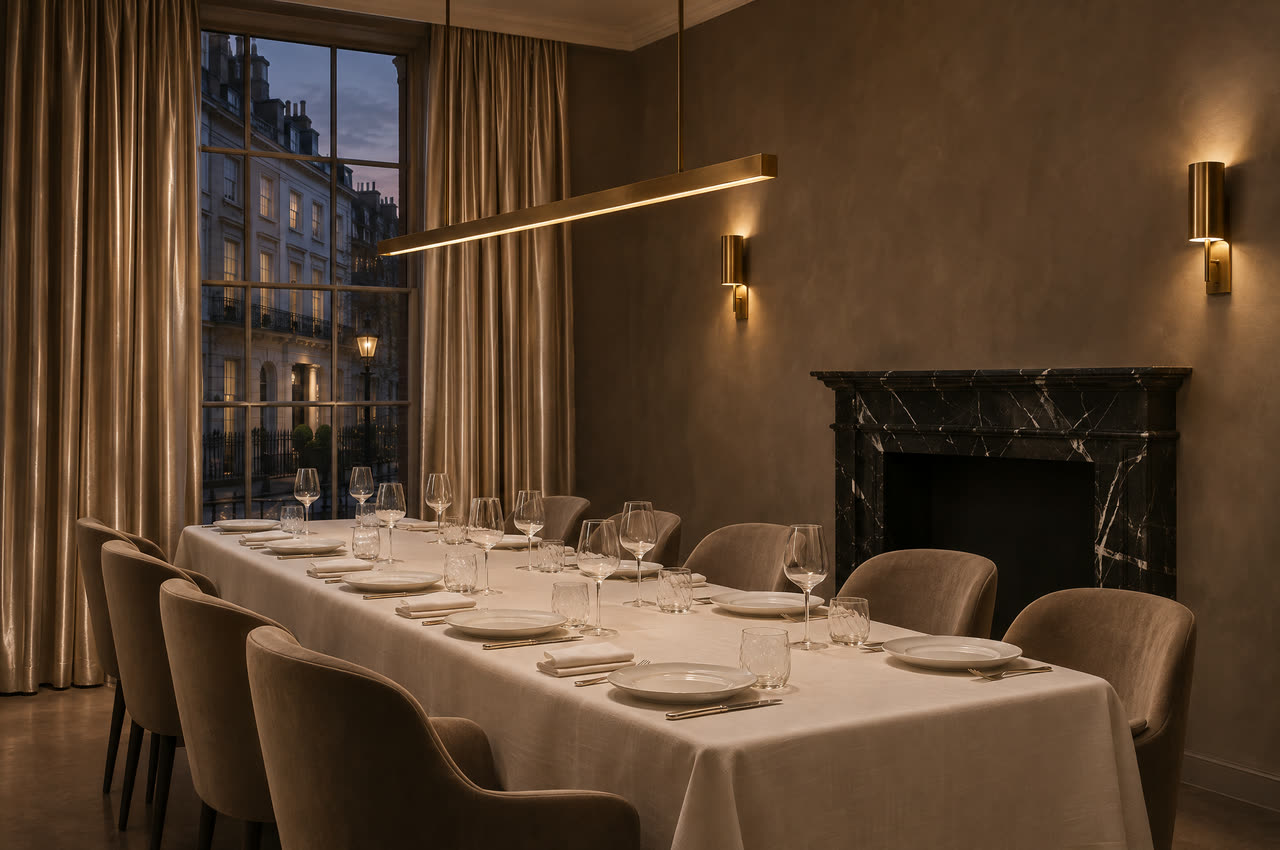
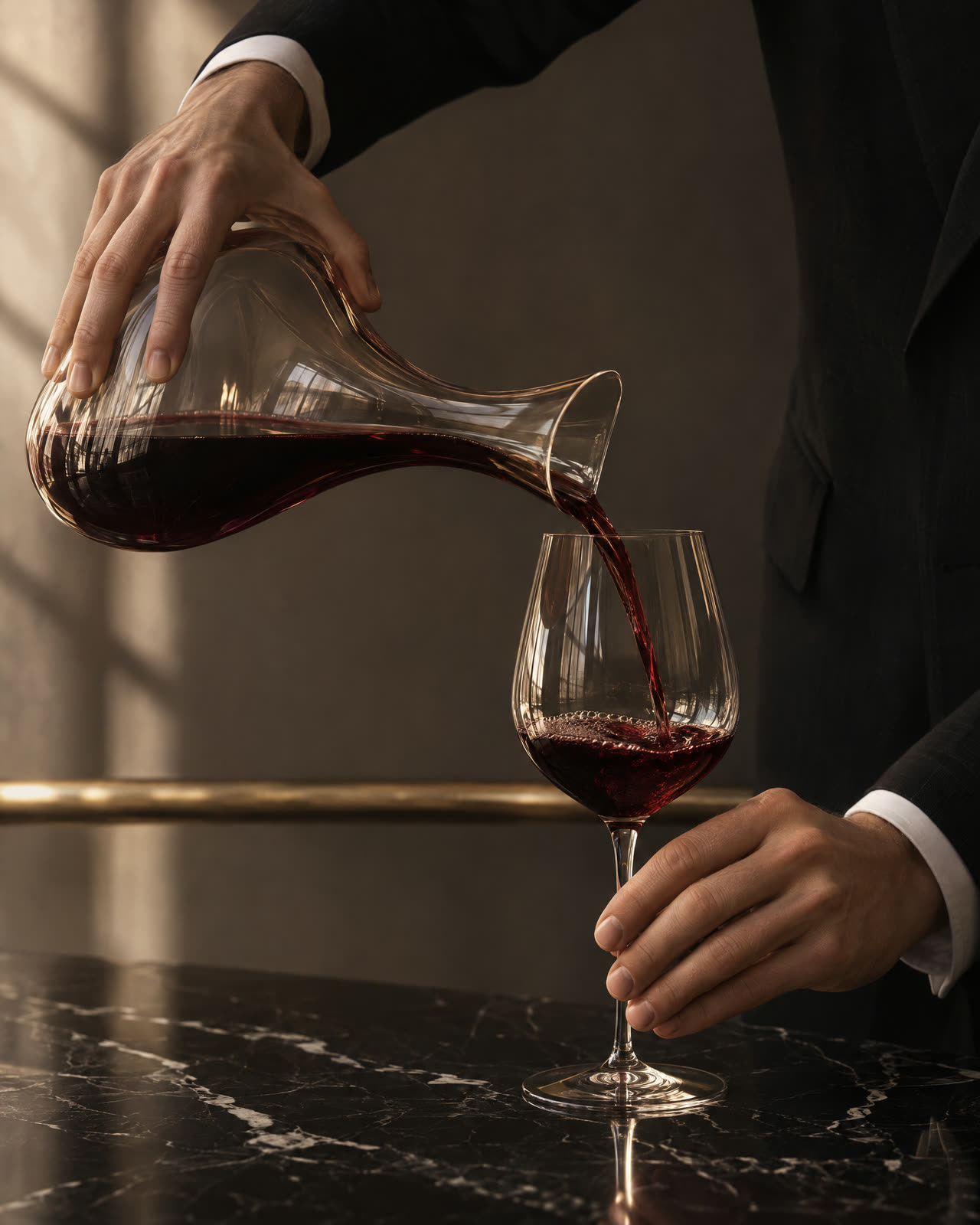
Eighteen generations through Higgsfield with GPT Image 2.6 at 2K, every frame reviewed before use. Seventeen are on the page: the hall, the bar, a place setting, the private room, the cellar, a sommelier decanting, the façade and ten dishes. The first façade came back as painted brick with window boxes and a gas lantern; the brief ruled out brick, so it was rejected and regenerated as smooth black stucco.
Three dish descriptions were rewritten to match what the generations show: turbot with brown butter, pigeon with fig and Castelmagno, the torte with dark chocolate. Generated imagery is not photography, and the site and this page say so.
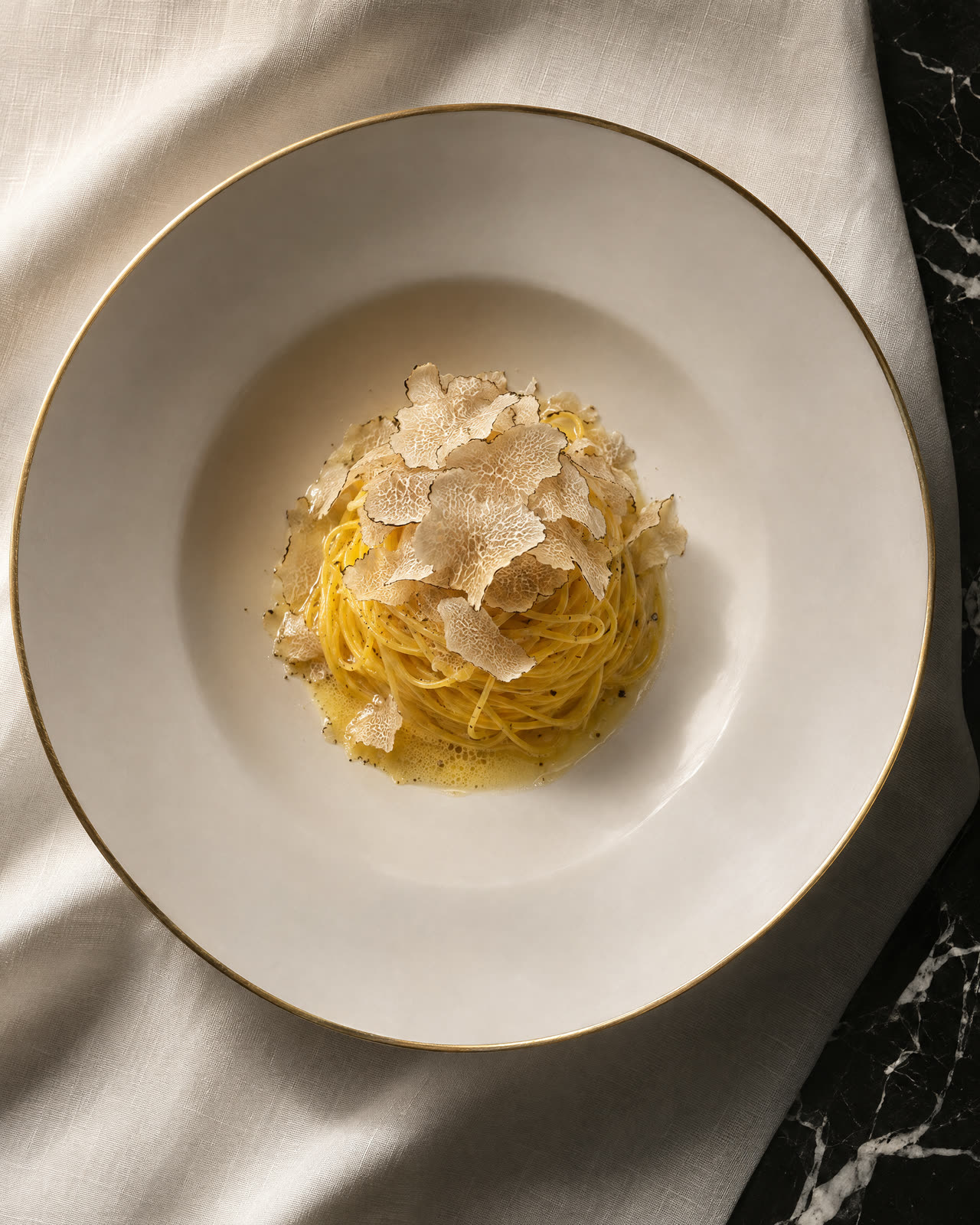
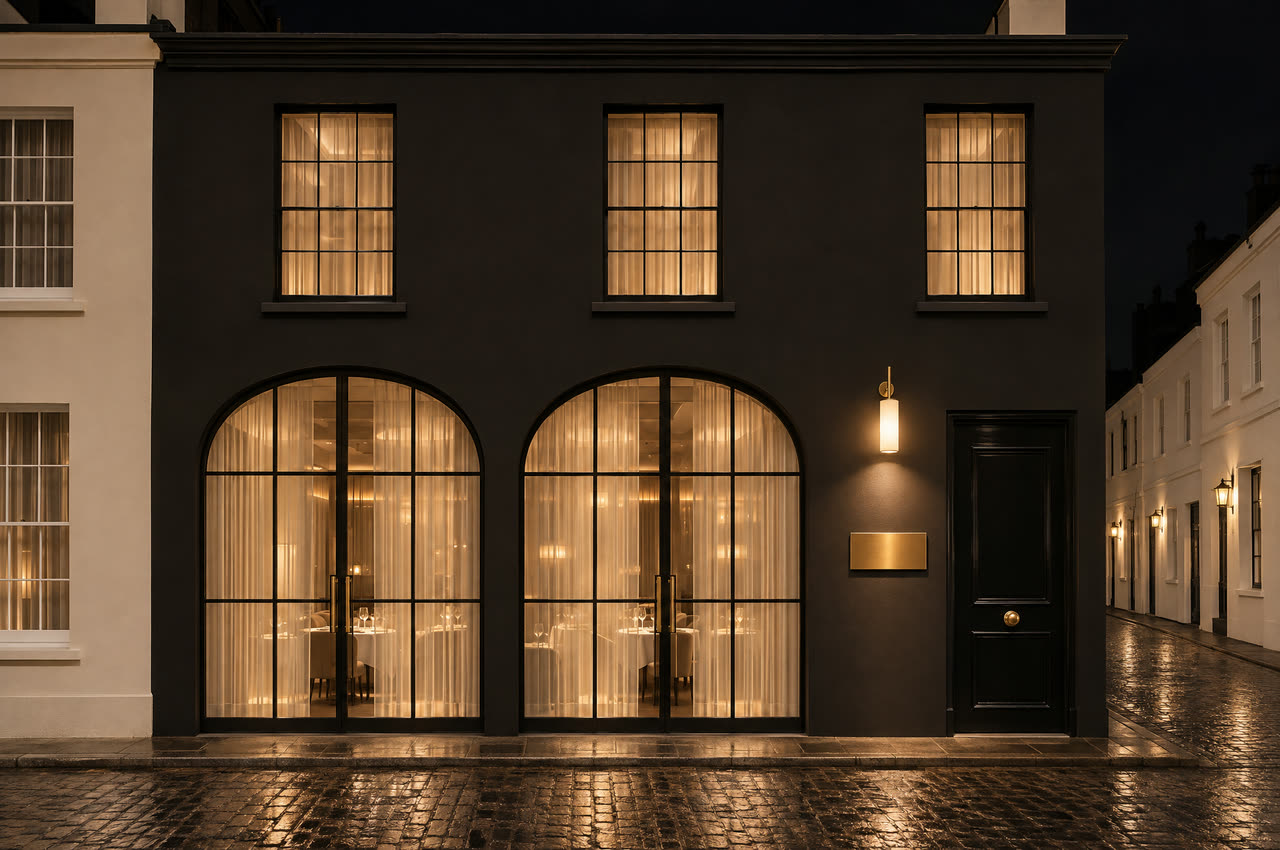
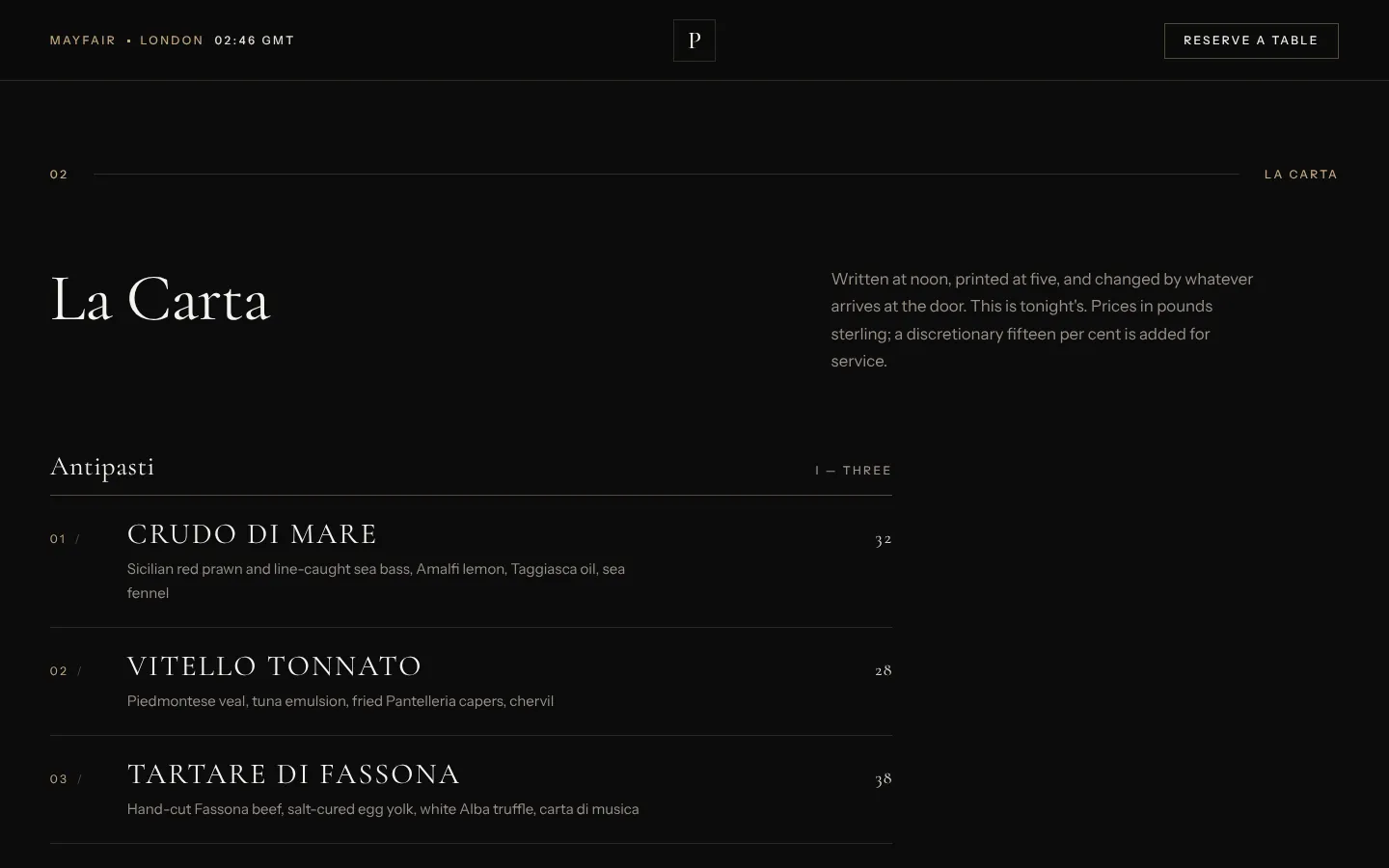
One page, four chapters, a dish that follows the cursor.
A single HTML file with its CSS and JavaScript embedded; a small Python script writes the picture markup and the monogram into it from a template. The header holds MAYFAIR · LONDON with a live London clock that switches to BST in summer, the monogram in the centre and Reserve a Table on the right.
In La Carta the courses alternate left and right across a twelve-column grid. On a desktop, hovering a dish shifts its name, turns it brass and unmasks a 4:5 photograph in the empty columns beside the list; on a phone each row opens its photograph inline. Rules draw out to full width as they enter the viewport and framed photographs move with scrubbed parallax. Reduced motion removes all of it, and with JavaScript off every block is visible.
QA on 8 November in headless Chrome at desktop, tablet and phone, plus a reduced-motion run: no failed requests, console errors, broken images or horizontal overflow, no element with a border radius, the monogram centred to the pixel at all three widths. On this site the fonts and the motion libraries are served locally instead of from Google Fonts and jsDelivr, so the page passes the studio's content security policy.
- 01Header: London clock, monogram, Reserve a Table. Background and hairline appear after 24px of scroll.
- 02Hero: four-line headline, the carriage hall unveiled by a clip-path wipe.
- 03The Estate and Philosophy: statement, two framed photographs, the facts.
- 04La Carta: four courses, ten dishes, the hover preview.
- 05Private Dining and Concierge: Salone Privato for twelve, cantina tastings for six, the concierge.
- 06Concierge Reservations: booking policy, details, a recoloured Google map, the façade and footer.
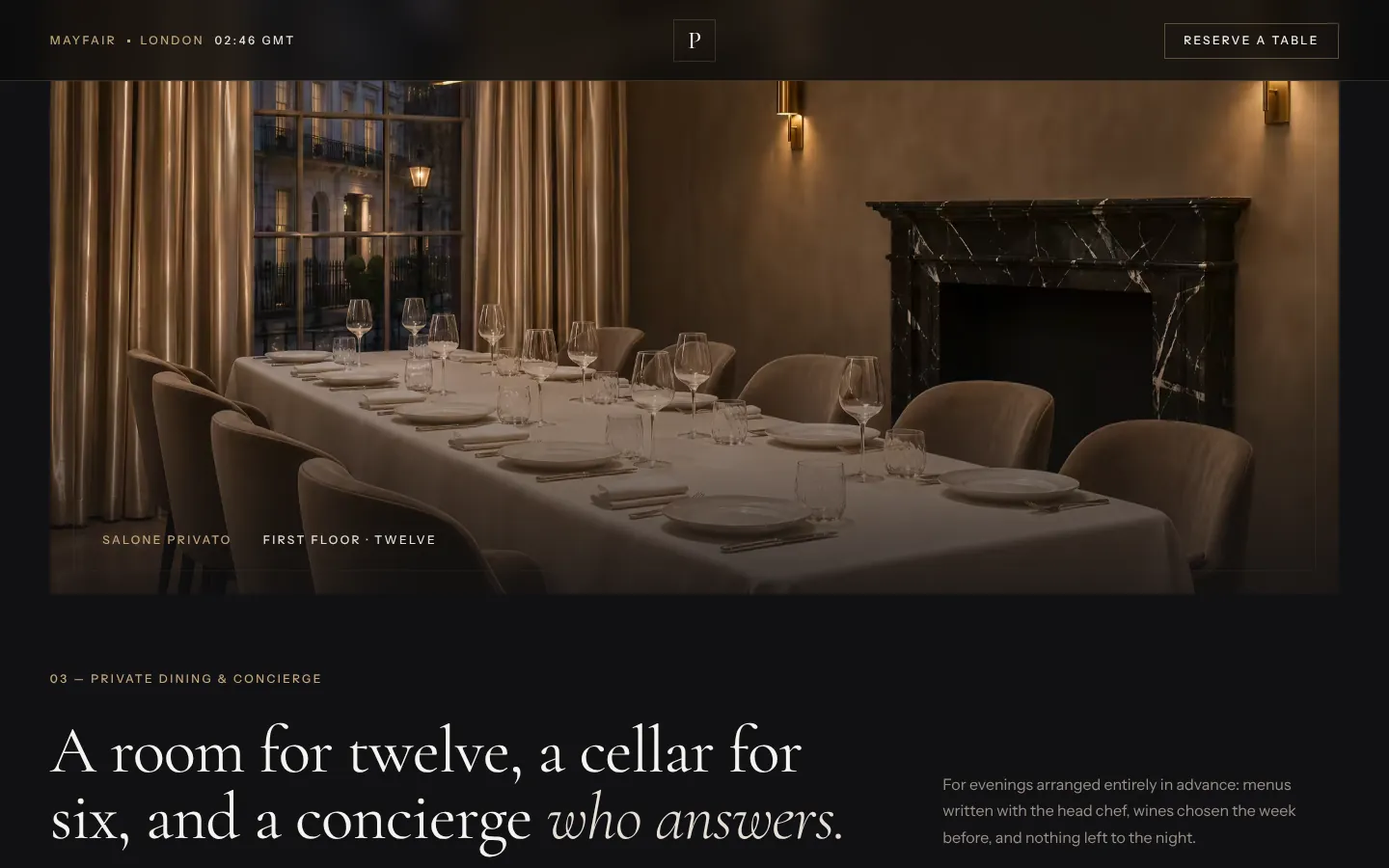
Type, code and what is invented.
Cormorant Garamond by Christian Thalmann; Instrument Sans by Rodrigo Fuenzalida and Jordan Egstad; both SIL OFL 1.1. GSAP and ScrollTrigger (Webflow, free licence) and Lenis (darkroom.engineering, MIT). Map by Google.
Hay's Mews is a real street; the house number, postcode, telephone, menu and prices are invented.